Passion & Purpose: Fall 2026
School districts provide brighter futures for rural students & communities
As the heart of rural communities, school districts set a cadence for much that flows through rural Missouri and beyond.
You see it at ballgames and community gatherings, showcases of support for “our” people and shared values. There’s economic value, as schools, especially in small communities, often serve as one of the largest employers around. But their presence is about even more than those collective community signposts.
“I want people to know that rural schools are the lifeblood of not only the community, but the state and the nation,” says Dr. Amy Padgett, superintendent of the Bakersfield School District in Ozark County. “This issue of rural education is way bigger than rural education. It is the backbone of our society.”
Among those shared versions of local love is a fact — a target — all these schools share: Preparing students for their futures. That’s through skill development, college prep, exploration of ideas, or connections with a trade.
“Our public schools are working day in and day out to make sure that students are ready to go out into the workforce,” says Dr. Josh Cotter, director of Southern Missouri Technical Institute in West Plains, a former public school teacher and a board member of the CFO. “I don’t know a single school that we work with that says, ‘I don’t care what happens once they get out of my doors.’”
Creating Opportunities for Homegrown Talent
The bottom line: Missouri’s public schools create pipelines and opportunities to prepare students to earn a living after school ends. It’s also part of a statewide priority.
“It is a cornerstone of the ‘American Dream,’” says Dr. Karla Eslinger, a former educator who retired as Missouri’s Commissioner of Education in 2026. She points to the World War II era when some countries chose not to prioritize education.
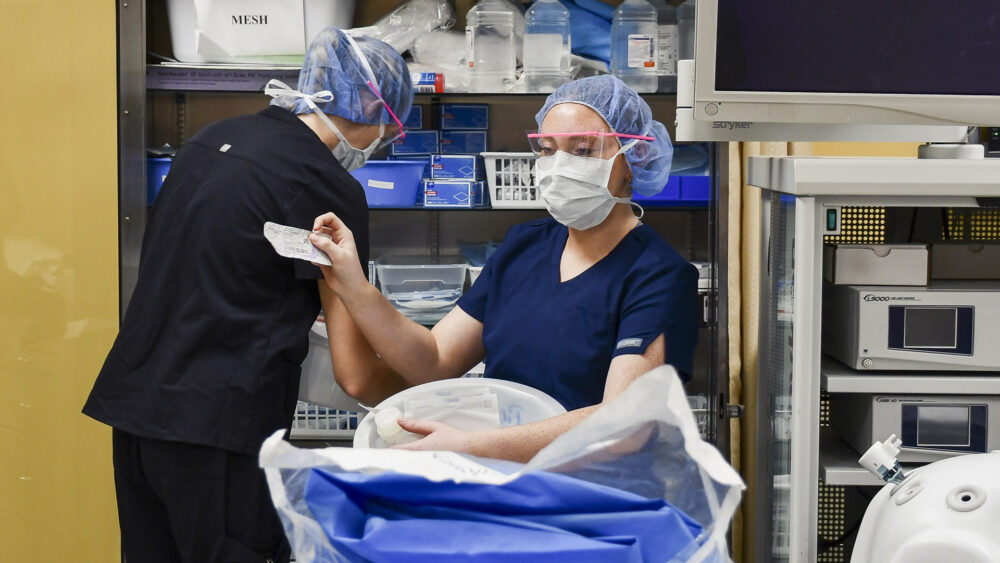
Southern Missouri Technical Institute provides hands-on experience to nursing students. The technical school draws students from 13 school districts, which fund tuition and transportation to its campus in West Plains.
“But in the United States, we decided to come together and help each other and make sure everybody had the same opportunities. There’s a difference. You have communism and socialism and fascism, but you don’t have that here. And the reason is because we take care of each other, and the first thing you do is make sure everybody has a fair playing field.”
According to the Missouri Department of Higher Education and Workforce Development’s 2025 annual report, 65% of jobs in Missouri by 2032 will require education and training beyond a high school diploma — a list that includes apprenticeships, certificates, associate degrees and professional education.
That objective includes two goals: That 60% of working-age Missourians ages 25 to 64 will earn a postsecondary degree or credential, and a 70% participation rate in the labor force to support Missouri’s economic growth.
“As of the most recent data, 52.2% of working-age adults had earned a credential, and 63.1% were actively participating in the labor force,” the report notes. “These updated figures reflect incremental progress toward Missouri’s long-term goals and underscore the continued need to expand access to education and training opportunities across all regions and populations.”
Local school districts are working to meet that moment. At Everton R-III, a district northwest of Springfield with about 170 total students, that work includes homegrown apprenticeship programs focused on education, maintenance and healthcare.
“We do a lot of our apprenticeships on campus,” says Dr. Will Darter, superintendent of the Dade County district. “So the minute that they graduate, they have a skill, but also they have been working, and they’ve been earning money as a young person with experiences.”
Everton is also gearing up for the creation of a new school farm, a reflection of local desire to help students earn industry-recognized credentials in areas like livestock valuation, dairy cattle, soils and small gas engines.
“All of that just opens up doors for our students,” says J.T. Asher, the school’s ag teacher, of the work and credentials. “I’ve had students that use this same curriculum and those certifications to leverage jobs and become successful in those different areas.”
About 135 miles southeast of Everton, that work is also seen at Bakersfield, a community of about 185 people in Ozark County. Through passed-down connections, boiler-making has become a desired career path for local students, prompting the school to start its own welding-trades program.
For those seeking training in other industries, Bakersfield is one of 13 south-central high schools that buses students to SoMoTech in West Plains — five days a week, even though Bakersfield is a four-day school — to earn certifications prior to graduation.
“Our kids that take our vocational courses, they’re very committed to school,” says Stephanie Guffey, Bakersfield’s high school principal. “They’re willing to go beyond what the rest of our student body does, and willingly take it, just to be able to set themselves up for career success.”
Across Missouri, technical education is seeing an increase. According to the 2025 MDHEWD report, enrollment in public community and technical colleges grew 2.9% between 2020 and 2024, with 4.3% growth from ’23 to ’24.
That opportunity for career and technical education is a win for students, particularly in rural areas with high levels of poverty, says Cotter.
“Our area is particularly impoverished — I mean, that’s the kindest word I can use,” he says. “(Career and technical education), in my opinion, is the fastest way out of that.”
That “grow-your-own” ethos is at the heart of SoMoTech, which began in 1970 when locals saw a need for nurses. In response, they passed a levy to fund the creation of the institute. Today, much of its work is partnering with local high schools to get students ready to hit the ground running after graduation through certifications and “stackable” credentials. In SoMoTech’s case, schools pay the students’ expenses — kept as low as possible, but still about $2,100 a year per student — and transportation costs.
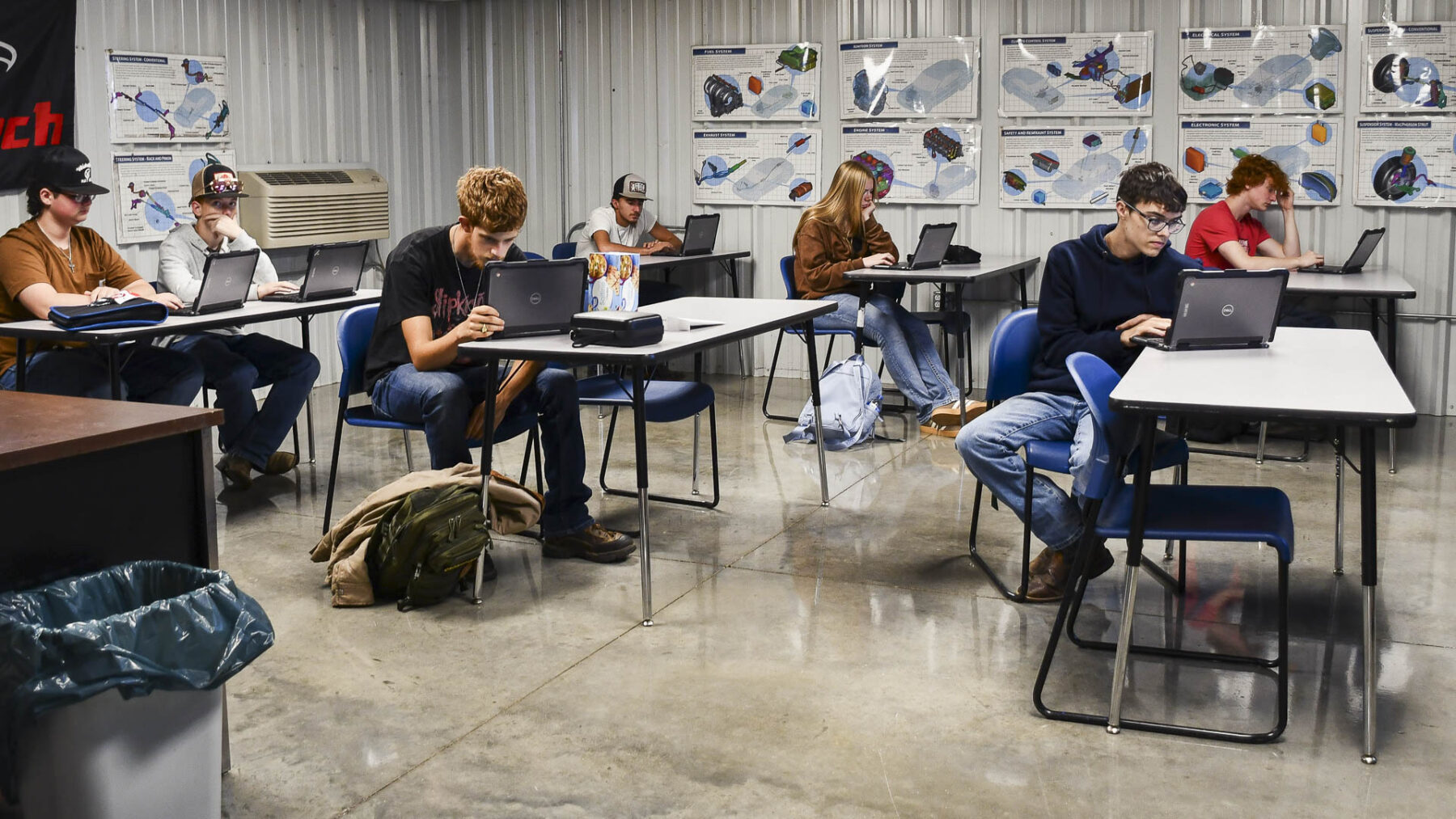
High school students from districts around West Plains study auto mechanics technology, one of the programs offered by Southern Missouri Technical Institute.
“They are ready to go to work when they’re done,” Cotter says, giving an example of the school’s welding program: “A high school student comes through here for two years and could theoretically get a job ... for $30 an hour.”
Rural districts also connect students with focuses like science and technology. In Bakersfield, a biomedical class for high school students features a new “Anatomage” table, allowing students to virtually see layers of body systems. The class, as well as one in the Clearwater School District in Piedmont, are delivered as part of “Project Lead the Way,” a curriculum that focuses on linking students to “career-connected learning experiences,” as PLTW’s website notes.
“We want ways to help prepare our students who are underserved and impoverished to be able to have some experience, or have a step up,” says Jessica Polk Sentell, a board member for the Clearwater School Foundation. “Maybe they don’t think they’re qualified, or maybe they’ve never seen anybody in their family do that. (We’re) trying to provide some of those types of opportunities.”
“It lets them think, ‘Maybe I can do this. Maybe this is a possibility for me,’ and I think that’s really, really important for students.”
How does this work happen?
These efforts and many others take more than can-do attitude.
They cost money — a factor that has become increasingly challenging as districts are faced with questions about funding. The issue runs from the creation of new statewide formulas to local questions, such as Senate Bill 3, which limited property tax increases in some counties and circumstances across Missouri.
Grant funding can help. The PLTW curriculum at Clearwater was made possible by a $23,350 grant from the CFO and the Louis L. and Julia Dorothy Coover Charitable Foundation. That Anatomage table now at Bakersfield? It cost $125,000 and arrived over the summer thanks to grant funding.
But as those districts know, funding doesn’t always work out. Both districts lost other grants they had been awarded, either through recission or an unexpected inability to make the required match due to other cuts.
Finding sustainable, reliable solutions that school districts can count on is part of how this work endures. And, at the end of the school day, the benefit to the student is also a benefit to the state.
“So many of our kids are very good at hard work,” says Guffey, Bakersfield’s principal. “What I think keeps our infrastructure together and our country together, it is the people who have that work ethic in rural America.”
—by Kaitlyn McConnell
Funding uncertainties challenge school districts across Missouri
Missouri’s public schools are at a crossroads of change as the state grapples with teacher shortages, focus on alternative educational options, local funding shifts and adjustments to a formula that helps fund districts’ operation. Those questions exist alongside the fundamental goal of public schools: to improve life, both now and in the future.
“The bottom line of education has to be quality programs where kids are prepared to fulfill their goals,” says Dr. Karla Eslinger, a former educator who retired as Missouri’s Commissioner of Education earlier this year. “You don’t want to give somebody an inadequate experience just because they live in a ZIP code that’s very rural. I think it’s our responsibility as a state to ensure that no matter where a kid lives, they have access to high-quality programs.”
Generally speaking, funding for Missouri public schools comes from federal, state and local dollars, an equation that means every district’s budget is unique. To help ensure districts have funding to operate, Missouri has used a formula — largely unchanged since 2005 — to determine the state funding each district receives.
It’s now under review: A task force, appointed by Gov. Mike Kehoe, has been given the responsibility of modernizing the formula. Among other focuses, they are asked to consider the equality of all students, sustainability, incentives and support for non-traditional public school options.
The task force’s feedback is due by December. After that, up to three recommendations will go to the governor, who in turn will pass recommendations to legislators. That uncertainty is a shared concern among Missouri educators, Eslinger says.
“The major concern is the unknown because they don’t know what the new funding formula is going to actually be,” Eslinger says. “Once that task force even finishes their work, it’s handed to the legislators, and the legislators can do whatever they want to with these suggested formulas.”
That question is alongside a need for teachers. According to Saint Louis University’s PRiME Center, which provides evidence on education research and policy for Missouri students, the state’s teacher turnover is more than twice the national average.
That loss is particularly relevant early in teachers’ careers; the center notes that just six in 10 teachers remain in Missouri public education through their sixth year.
“It’s also especially high among teachers of color, and teachers in urban, rural and disproportionally low-income school environments,” the center notes.
That turnover also has real educational implications, too, as high turnover is linked to declines in student outcomes. Such factors make this a challenging moment for schools, particularly as public education has become increasingly politicized.
“It’s not supposed to be a political volleyball (but) public education is a very easy target — very easy,” Eslinger says. “And so people use it.”
—by Kaitlyn McConnell