
Passion & Purpose: Spring 2026
Mission-Related Investments Generate Capital for Future Community Projects
Big ideas for community good often need capital, but organizations leading those projects don’t always have access to funds to make them happen.
The Community Foundation of the Ozarks offers a solution through its Mission-Related Investment program, which provides loan options to nonprofits at below-market rates for projects that create a community benefit.
“Many nonprofits seeking financing through the MRI program are unable to access traditional bank loans due to balance sheet constraints or operating uncertainties typical of the sector,” says Luis Leon, the CFO’s chief financial officer and executive vice president. “The CFO plays a complementary role by filling this financing gap, rather than competing with local financial institutions.”
Also known as “impact investing,” the program invests in community needs that might not otherwise qualify for financing. As loans are repaid, the capital can be recycled and reinvested into new community priorities.
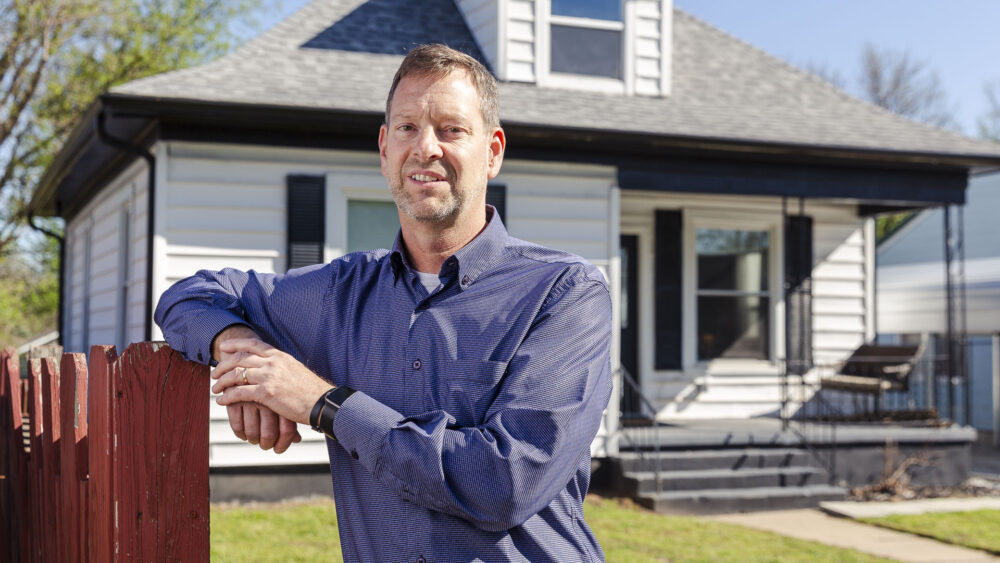
Brendan Griesemer leads Restore SGF, which recently established a revolving loan fund through the CFO’s Mission-Related Investment program. Restore SGF works to support renovations — like at this home in the Grant Beach neighborhood — and improve home-ownership rates in Springfield. (Photo by Aaron Scott)
“To ensure prudent stewardship of charitable assets, nonprofit borrowers are required to offer collateral — typically in the form of a hard asset — as security for the loan,” Leon notes. “In many cases, the CFO’s initial participation helps build an organization’s financial track record and credibility, positioning them to successfully pursue conventional financing for future projects. In this way, our involvement not only addresses immediate capital needs but also strengthens the long‑term financial sustainability of nonprofit partners.”
A catalyst for housing needs
Restore SGF is a Springfield-based nonprofit that focuses on improving rates of local homeownership.
“We’ve got two main pillars of our mission: One is to increase home ownership and the other is to improve housing quality in Springfield,” says Brendan Griesemer, Restore SGF’s executive director. “We are looking at using housing as a neighborhood revitalization tool.”
The CFO committed $500,000 from its MRI program to Restore SGF’s Revolving Loan Fund. This catalyzed six local financial institutions to invest an additional $2 million. With this fund, Restore SGF will either rehab existing housing or purchase property for new construction. Then, when those properties sell, the loan will be repaid.
“Basically, it’s just like borrowing funds from a bank,” Griesemer says. “When that is sold to that next homebuyer, when they repay that, it goes back into the fund. And then it just revolves back out. It becomes this continually revolving line of credit.”
Having that funding is important to this effort’s success, Griesemer says. “We’ve got this consortium of banks and the Community Foundation that have come together to provide this capital to our organization,” he says. “I don’t know that we would get to a point to be able to do it on our own. I think that having that access to that capital for these types of projects is extremely important.”
Though not supported by the revolving loan fund, Restore SGF also offers down payment assistance to first-time home buyers in qualifying situations, funding for “curb appeal” improvements, and accessibility improvements for senior citizens.
“Having all of these pieces together, in conjunction with each other, can begin to move the needle,” Griesemer says of Springfield’s home ownership realities. “You want new homeowners to raise the home-ownership rate in Springfield neighborhoods, but you also need to have good housing quality and good housing in those neighborhoods that people you know would like to move into. These are all pieces that fit together in this puzzle.”
Supporting regional impact
Since the MRI program’s inception, the CFO has distributed about $10 million to 28 entities across the region.
“It’s great to be a part of the CFO’s Mission-Related Investments committee and witness firsthand the many ways this program directly impacts nonprofits in the Ozarks with these creative financing solutions,” says Steve Kelly, the committee’s chair. “We have room to expand the program and are eager to find ways to help nonprofits grow their impact.”
The list of projects includes:
- The purchase of an MRI machine to better serve patients at Salem Memorial District Hospital in Dent County, which received $862,000 for the project.
- The expansion of the Jordan Valley Innovation Center, which was assisted by $1.6 million in stop-gap funding allocated to the Missouri State University Foundation.
- The Respond, Recover, Rebuild Program, which the CFO launched during the COVID-19 pandemic, provided $210,000 in bridge financing to five arts organizations facing temporary funding disruptions.
- In 2020, Ozark Greenways received financing to build a 1.4 mile section of the Fulbright Spring Greenway, providing a new recreational opportunity in Greene County.
- Watershed Committee of the Ozarks received a loan for start-up costs when it took over operations of Fellows Lake Marina in 2021.
“This program would not be possible without the leadership and oversight of the CFO Board of Directors and the Mission‑Related Investments Committee,” Leon says, noting a recent action of the CFO’s board to increase the funds available for MRIs to more than $6 million, which grows along with the CFO’s primary investment pool. “The board’s decision reflects a thoughtful balance between fiduciary stewardship and bold, mission‑driven action.”
—by Kaitlyn McConnell