

Passion & Purpose: Summer 2026
Fertilized by philanthropy, ag education prepares young farmers for bountiful futures
Agriculture has helped sustain the Ozarks. Since the earliest family farms and its heyday in the fruit and dairy industries, the land has long been part of the “why” people came here and the structure of their lives.
The landscape looks different today than it did when many were twice-daily milking dairy cattle, growing farm-like gardens to feed families or working at tiny canning factories to earn some cash money. The industry’s impact, like the people and their use of available technology, has evolved.
But its broader presence persists. According to the Missouri Department of Agriculture, the industry was expected to have a $93.7 billion impact on the state’s economy in recent years.
On a grassroots level, that work is visible through rural schools, where agriculture and FFA programs still develop students’ home-based farming skills. Others study it after high school. Its place is also seen through bigger business pursuits that choose to base their operations in the Ozarks. That’s not to mention adults who may not be preparing to run a family farm, but have an interest in things like urban gardening, beekeeping or community building.
“There’s never been a time where education is more important than now. Things are always changing, and in particular with agriculture,” says Kyle Whittaker, a retired ag teacher who now works as a University of Missouri Extension specialist. He says ag education can be a fit for a lot of students because it teaches skills in so many different areas.
“Is it for everybody? Probably not, but I think it’s grown because kids see it as different, and it’s very diverse. It’s very diverse. I mean, if they stay in the program, they could literally learn countless different content areas.”
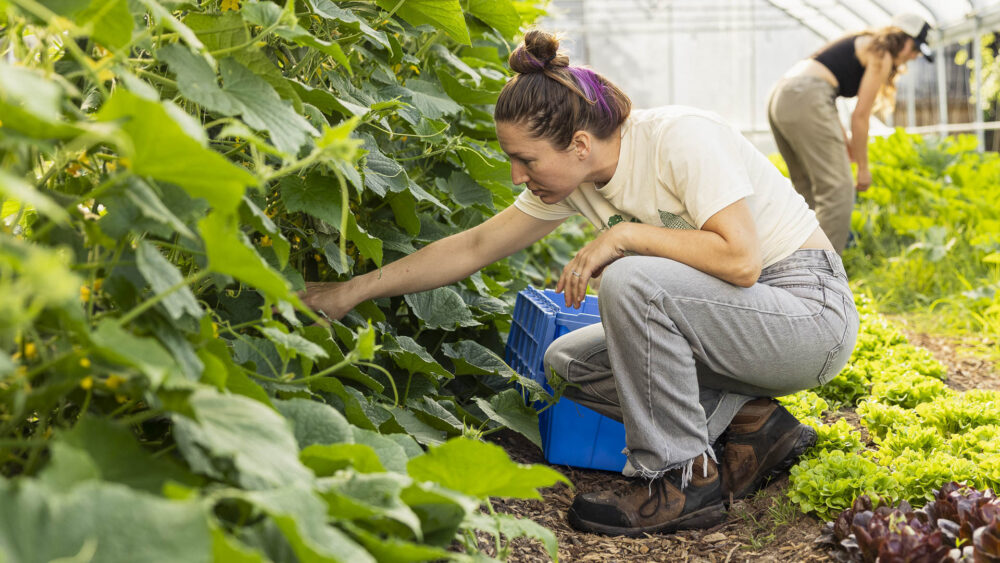
Emily Franklin, staff member of Springfield Community Gardens, harvests cucumbers at the nonprofit’s new Osage Prairie Farm in Springfield. SGC staff serve as educators for its farmer incubator program.
Harvesting Philanthropic Support
While agriculture is very much a business, philanthropy makes a difference in supporting future farmers. Through the CFO, several programs are designed to support regional ag-related efforts.
“Agriculture is foundational to community life and economic development in rural Missouri,” says Ashley Walden, vice president of community impact at the CFO. “Programs that train our kids ultimately enrich our communities by helping prepare them for their futures, whether that’s in STEM, an ag-based career or managing their own agricultural pursuits. The CFO is pleased to partner with organizations and donors to help further these missions.”
An example is the Vital Farms Local Impact Grantmaking Program, which reflects the company’s mission to enhance outdoor spaces in the communities where its network of more than 600 farms is located.
Individual decisions have made a big difference, too. Through a planned gift in their estate, the late Clinton and Nancy Schilling donated farmland they owned across Barton, Dade and Jasper counties to support the Schilling Community Fund and a scholarship endowment for students in that tri-county area.
Danny Little, a Lamar-based businessman, and his wife Jewell have made significant contributions through their donor-advised fund to champion agricultural projects like the Show Me Youth Ag Academy. Other funding has supported the purchase and distribution of chicken coops to kids through the Barton County Extension.
“Now we have our own coop, so we have our chickens by themselves,” says Kirsyn White, whose family received a coop through the program. She says it’s better because it’s larger, easier to clean and offers protection from predators on their farm near Lamar.
“They’re healthier, and they all have their own space,” she says of the birds. “A chicken — if they’re not happy, their tails kind of stay down, but these guys always have their tails up, so I think they’re happy.”
On a more regional scale, Springfield Community Gardens is an example of how philanthropy can fuel connections to fresh, local food. Most recently, a grant from the Jewell Schweitzer Quality of Life grant program provided $30,000 to support the relocation of one of its Springfield farms, where it hosts farmer-education programming.
“Our hope is that we really hyper-localize our food system,” says Maile Auterson, SCG’s founding executive director. That mission can be found even in urban areas, as SCG maintains about 20 sites in Springfield dedicated to local food.
Putting Education into Practice
Education has long been part of sustainable agriculture. For example, SCG trains future farmers in its farms and gardens. Sometimes that’s formally through internships, while at others it’s by naturally integrating locals into the grassroots mission around local food.
“We’ve got crops growing right down the street for the schools and the senior centers,” Auterson says, speaking of SCG’s new Osage Prairie Farm in Springfield. “They’re growing a little more scratch food, so it is for the salad bars, but (it’s also) to get the students interacting with the farm.”
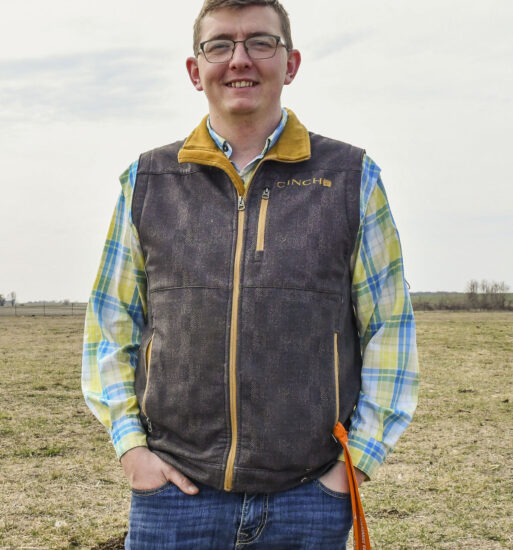
Michael Lee, the Golden City School District’s agricultural teacher, says the hands-on experiences provide agricultural lessons for life. “That’s the whole purpose behind the ‘school farm’ concept. ... (It’s about) having the experience and knowledge — if they want to raise their own beef or own hog for their family, they have a concept of how to do it.”
Agricultural knowledge is often passed down in families from one generation to the next. It’s also found in classrooms — where ag education can mean more than simply learning about farming best practices.
“Ultimately, what we want for students to do is to become productive citizens,” Whittaker says, noting skills like problem-solving, critical-thinking and people skills are on that priority list. Developing those qualities is part of helping students become successful adults, even as ag education has shifted over time.
An example is Future Farmers of America, established in Kansas City in 1928. Throughout rural areas, the program — now known officially as FFA — integrates with ag education to help students become self-sufficient problem solvers more than strictly learn how to run a farm.
Michael Lee, agriculture teacher at Golden City High School, sees this firsthand. The Ozarks native says there’s been a shift in the number of kids who come to school with ag knowledge today compared to when he was in high school.
“Fifteen years ago, when I was in school, a lot of kids still lived on the farm, and they learned all this stuff at home,” he says, noting that there are far fewer today with that background.
Golden City R-III has received $80,000 in grant support from the Schilling fund to support an animal science laboratory for a hands-on learning environment for students enrolled in agriculture, food and natural resources courses. Another grant round supplied funding to create a non-ruminant animal addition, purchase a floral cooler and expand the welding area.
Collectively, that support creates an environment where kids can learn skills to help them integrate agriculture into their future.
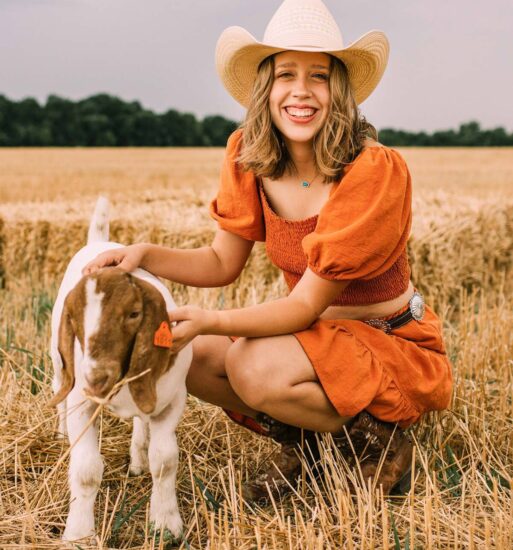
“I want to be a part of something that looks at how we can make agriculture more sustainable and how we can feed people better.”
— Emily Nelson, Schilling Scholarship Recipient
“That’s the whole purpose behind the ‘school farm’ concept,” Lee says. “I’m not trying to come out of this having kids going out and being feedlot managers in Kansas and running 8,000 head of cattle. (It’s about) having the experience and knowledge — if they want to raise their own beef or own hog for their family, they have a concept of how to do it.”
Beyond the Farm
Others apply that information to careers in related fields. Emily Nelson, a graduate of Joplin High School, got interested in agriculture in seventh grade when a local farmer visited during career day. Years later, she became an FFA leader and received a scholarship from the Schilling fund. It helped her graduate from Cornell University, the only Ivy League university with a dedicated school of agriculture.
“It just afforded me a lot of opportunities,” Nelson says of the scholarship, one of six awarded annually to students majoring in agriculture from select southwest Missouri counties. “We live in a broken world, and I want to be a part of something that changes it for everyone else to make it better.”
Today, the recent graduate — who completed studies in agriculture studies and economics — looks to impact the “greater good” intersection of farmers and consumers.
“People are talking about demonizing sugar or fats,” Nelson says, “or what sort of subsidies should we give farmers? What should they be growing? What should everyone be doing? I want to be a part of something that looks at how we can make agriculture more sustainable and how we can feed people better.”
Something that helps — whether it’s individuals working in agriculture, or larger efforts like SGC — is community support. Auterson gives an example of how funding from local partners helped SCG when federal funding was lost during recent recissions.
“It’s an important story for our community that everybody lifted us up in that time of really a lot of change,” she says. “The community just was so supportive. I think that’s really always important to emphasize, and then just the need for small farm support in the Ozarks — always. I’m always going to be preaching about that.”
— by Kaitlyn McConnell